
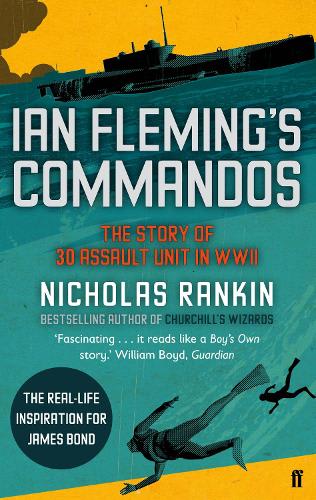
Ian Fleming's Commandos
Category
ISBN
9780571250639
Dimensions
0.98 x 4.92 x 7.87 inches (Length x Width x Height)
Brand

Minimum quantity
2
Author
Nicholas Rankin
Imprint
Faber & Faber
Format
bf
Pack quantity
32
Description
"Nicholas Rankin's fascinating book is an account of the 30AU's progress through the war. From time to time it reads like a Boy's Own story, so flamboyant are the characters and so vivid Rankin's accounts of the deadly scrapes and firefights the commandos found themselves involved in. The research is prodigious and lucid - now I finally understand how an Enigma machine works - and one gains a real sense of how these maverick units functioned, very much akin to the Long Range Desert Group and the fledgling SAS." - William Boyd, The Guardian
In 1941, the United Kingdom faced its darkest hour: it stood alone against the Germans, who had chased British forces out of France, Norway, and Greece. All it had left were desperate measures--commando raids, intelligence coups, feats of derring-do. Any such "novel enterprise," wrote Admiral John Godfrey, Director of Naval Intelligence, required "an officer with drive and imagination of the highest order." He found one in Commander Ian Fleming.
In Ian Fleming's Commandos, Nicholas Rankin tells the exciting story of a secret intelligence outfit conceived and organized by Fleming. Named 30 Assault Unit, the group was expected to seize enemy codebooks, cipher machines, and documents in high-stakes operations. Assault unit commandos fought in the North African campaign and the invasions of Sicily and Italy, poked over the bones of bombed Pantelleria, and liberated Capri. Rebranded '30 Assault Unit', they went ashore on D-Day, heading for rocket-sites and radar-stations. They helped liberate Paris (including the Ritz Bar and the Rothschild mansion) and then set out to steal scientific and industrial secrets from the heart of Germany. Their final amazing coup was to seize the entire archives of the German Navy's three hundred tons of documents. Ian Fleming flew out in person to accompany the loot back to Britain, where it was combed for evidence to use in the Nuremburg trials.